

What If Discipline Isn’t About Pushing Harder?
We tend to think of discipline as something hard.
Push through. Don’t quit. Do the work when you don’t feel like doing it. Hold yourself to a higher standard.
But what if discipline could actually make you more capable of enduring by asking you to be a little less hard on yourself?
That’s one of the ideas Aaron Hendon explored in his conversation with Greg McDonough on the Chief Endurance Officer podcast, and it offers a fascinating perspective on what endurance really looks like.
Aaron, a best-selling author, mindfulness instructor, keynote speaker, and serial entrepreneur, has spent years working with sales professionals, business leaders, and others on developing a more resilient mindset. His approach challenges the traditional idea that better performance comes from more pressure.
Instead, he defines discipline as:
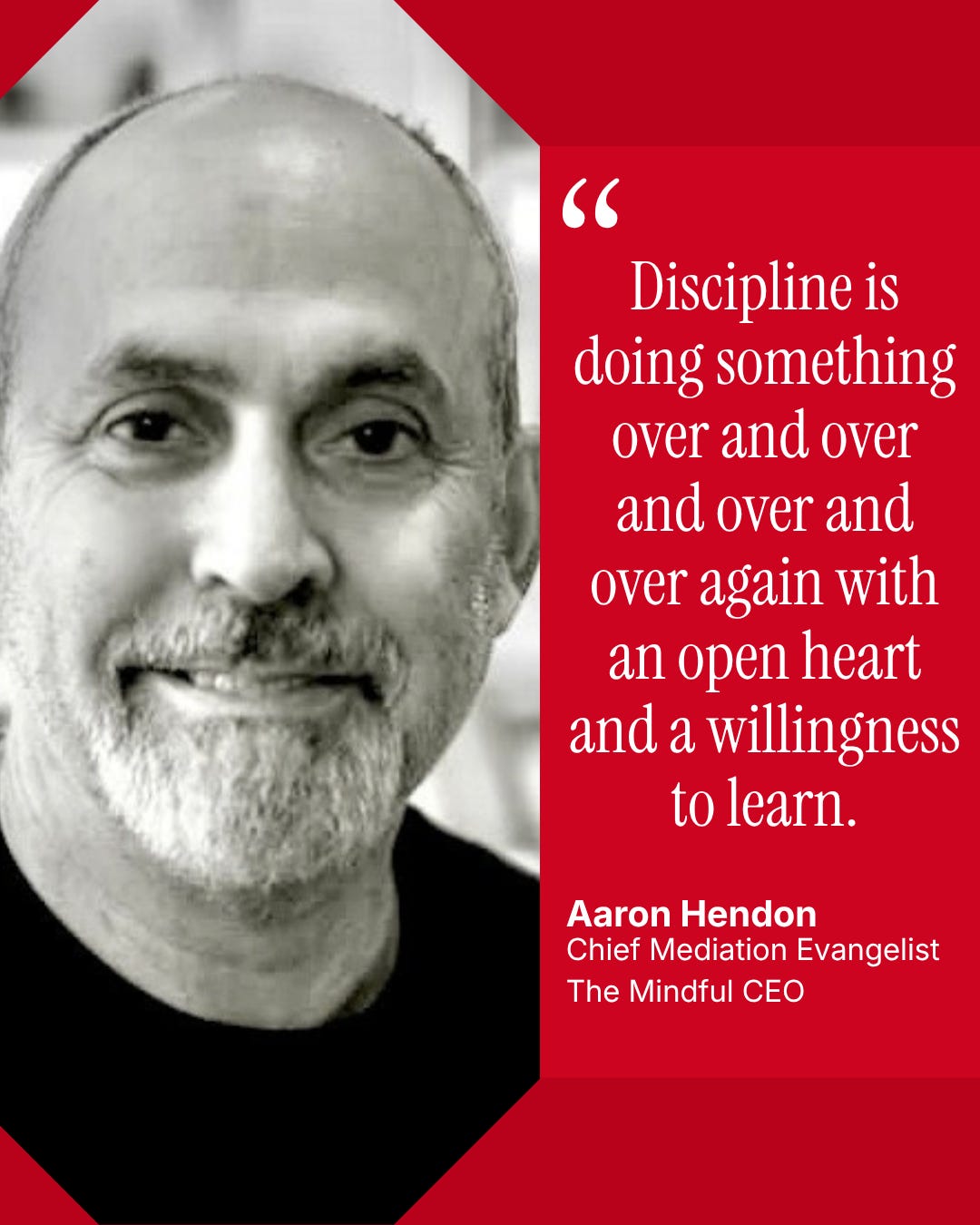
“Doing something over and over and over again with an open heart and a willingness to learn.”
That small shift in definition changes quite a bit.
The difference between pushing through and paying attention
Aaron points out that there is a difference between being tough and simply ignoring what your body is telling you.
He talks about learning to recognize the difference between exhaustion and resistance, and between taking a necessary break and making an excuse. The goal isn’t to eliminate discomfort. It’s to become more aware of what that discomfort is actually telling you.
For endurance athletes, that idea is particularly interesting.
Training requires consistency, but consistency doesn’t always mean doing more. Sometimes it means knowing when to push, when to recover, and when to pay closer attention.
And that same principle extends far beyond physical training.
Endurance is also an attention game
A major theme throughout Aaron’s conversation is mindfulness, but not necessarily in the way most people picture it.
For Aaron, mindfulness is fundamentally about training your attention.
Where is your attention right now? What are you actually noticing? Are you responding to what’s happening in front of you, or are you already replaying the past or preparing for what’s next?
He describes the mind as constantly wandering, comparing it to a puppy that keeps escaping its crate. The practice isn’t to punish the puppy for getting out. It’s simply to gently bring it back.
Again. And again. And again.
That is the practice.
And perhaps that’s where mindfulness and endurance intersect most clearly: the willingness to return to the work, without judgment, over and over again.
From getting results to learning through the process
Aaron also challenges the idea that pressure is what keeps high performers performing.
There’s often a fear that if we stop demanding so much of ourselves, we’ll stop accomplishing as much.
But Aaron suggests another possibility: what happens when you stop doing something only to get a particular result and start doing it because you genuinely love the process?
That shift can change the relationship we have with performance.
Instead of constantly asking, Did I win? Did I succeed? Did I do enough?
We can start asking:
What can I learn from this?
What is my body telling me?
Where is my attention?
What happens if I stay curious?
That may not sound like the traditional definition of endurance.
But maybe it should.
Aaron’s conversation with Greg is a thoughtful exploration of discipline, mindfulness, performance, and the ways we train ourselves to keep going. It’s a reminder that endurance isn’t always about finding the strength to push harder.
Sometimes, it’s about developing the awareness to know how to keep going well.
Listen to Aaron Hendon’s full conversation on the Chief Endurance Officer podcast to hear the rest of his perspective on discipline, mindfulness, performance, and building a more resilient mindset.