

Most endurance athletes and executives operate under an outdated, brute-force paradigm: more work equals more success.
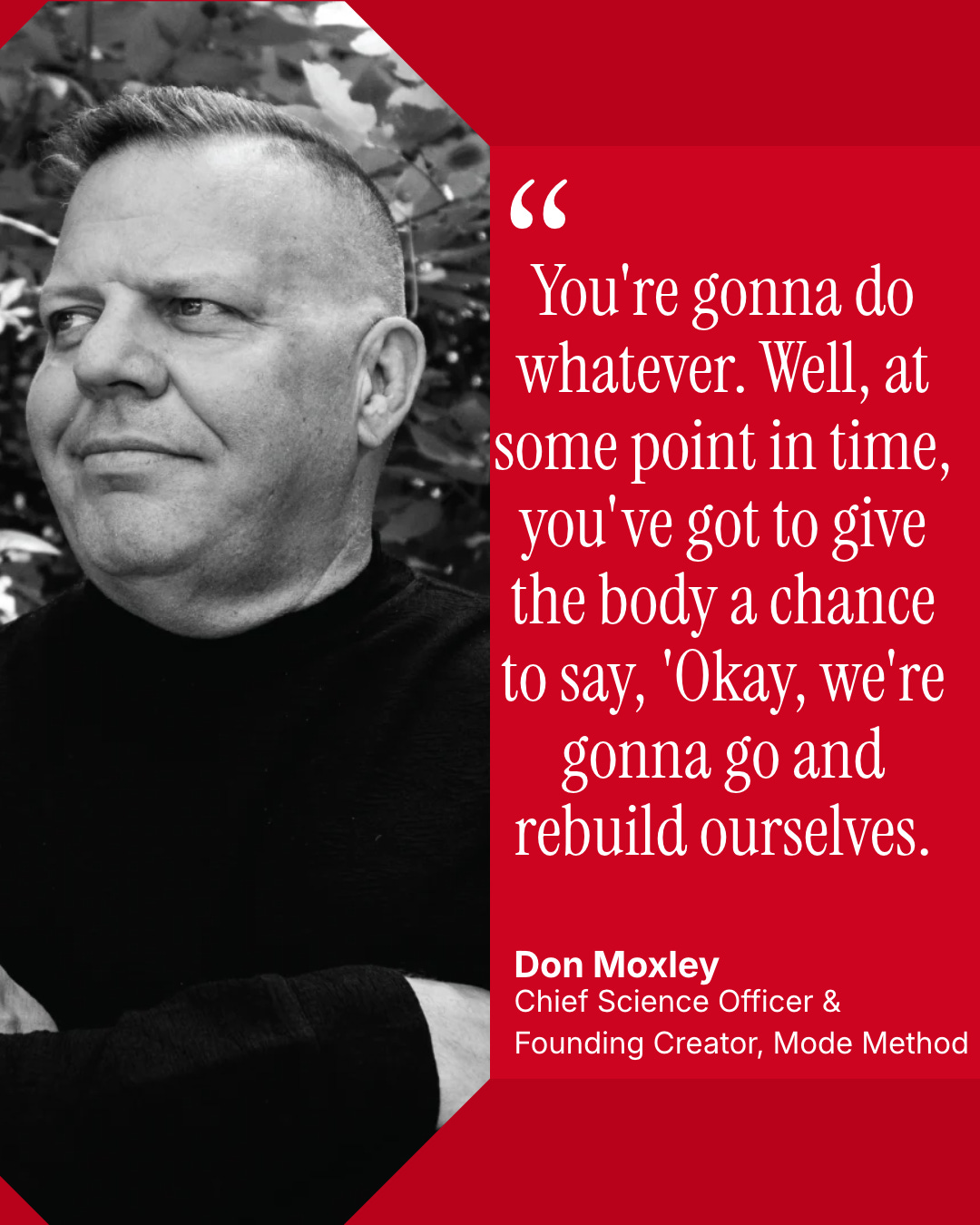
When performance dips, the default instinct is to double down, train harder, log more miles, or grind through longer hours. But according to pioneering sports scientist Don Moxley, that mentality ignores the fundamental laws of human physiology.
Don began his athletic life as a farm kid in eastern Ohio, bucking 10,000 bales of hay a day on cattle operations before wrestling as the starting heavyweight at Ohio State. Years later, when he returned to Ohio State as their first dedicated sports scientist, he wired elite wrestlers with heart rate variability (HRV) monitors and uncovered an undeniable biological truth: you cannot out-train a depleted autonomic nervous system.
The Three Rs: Resources, Resilience, and Recovery
Don visualizes human capacity as a bucket of resources. Every stressor - whether a tempo run, a heavy lift, an executive board presentation, or family tension - knocks a hole in that bucket.
Recovery is the only mechanism that refills it.
“All stress is equal... I don’t care if you’re doing a hard 10K run or you’re having to deal with the fact that your parents are getting divorced. Stress is stress, okay? And it’s going to have a similar effect on your autonomic system, your ability to manage this, and this entire process is about building resources so that we have the resilience to deal with the stress when it comes along.”
When Don began tracking Ohio State wrestlers, he realized that many elite athletes weren’t underperforming because of poor technique or lack of grit; they were suffering from maladaptation. By putting training controls on athletes whose resting HRV showed systemic depletion - pulling them out of grueling practices early and tailoring workouts to what their nervous systems could actually handle - those same athletes went from barely surviving matches to standing on the NCAA All-American podium.
The Illusion of Sleep Duration
Many high performers point to their sleep trackers and assume that eight hours in bed guarantees recovery.
Don’s research proves otherwise. In an experiment with a college wrestler, Don compared a baseline sober night of sleep against a night after consuming four beers.
The sleep duration was identical. But the biometrics painted a radically different picture:
“Went to bed same time, woke up the same time, same. But when you looked at the recovery, when you looked at the sympathetic/parasympathetic breakdown, his recovery was cut in half. So that sleep period delivered half of the resources than what the night before. The alcohol took half of the resources.”
Metabolic Economics
Wearables like Oura and Whoop have flooded consumer markets, but without understanding the autonomic nervous system, a wearable is just another gadget delivering an arbitrary checklist.
HRV measures the subtle time differences between heartbeats, reflecting the balance between the sympathetic (”fight-or-flight”) and parasympathetic (”rest-and-digest”) branches. A higher HRV indicates a resilient, adaptable nervous system primed to take on strain.
“People who use HRV-guided training programs, well, they will achieve the same goal as someone using an off-the-shelf training program... but they’ll do it doing less work,” Don explains. “This is metabolic economics. You’re getting a greater return on investment when you do this.”
If you want to perform at your peak - whether running an ultramarathon or leading an enterprise - stop chasing arbitrary mileage and start managing your systemic resources.